

When I first got into recovery I thought my family’s rules were punishment. “Why do they need to know where I am?” I’d think. “Why won’t they lend me money?” To me it felt like control.
I was wrong. Real boundaries aren’t about control — they’re about safety, clarity, and trust. Done well, a boundary protects your loved one’s recovery and protects the family from chaos, resentment, and repeated harm. Below I explain the why behind five common boundaries, what each one builds or protects, and how to say them so they actually work.
- Nii
Quick truth: boundaries aren’t walls — they’re bridges
A boundary says: “I love you, and this is how I can keep helping in a way that doesn’t hurt either of us.” When you stick to your boundary calmly and predictably, you replace chaos with a predictable environment where recovery can grow.
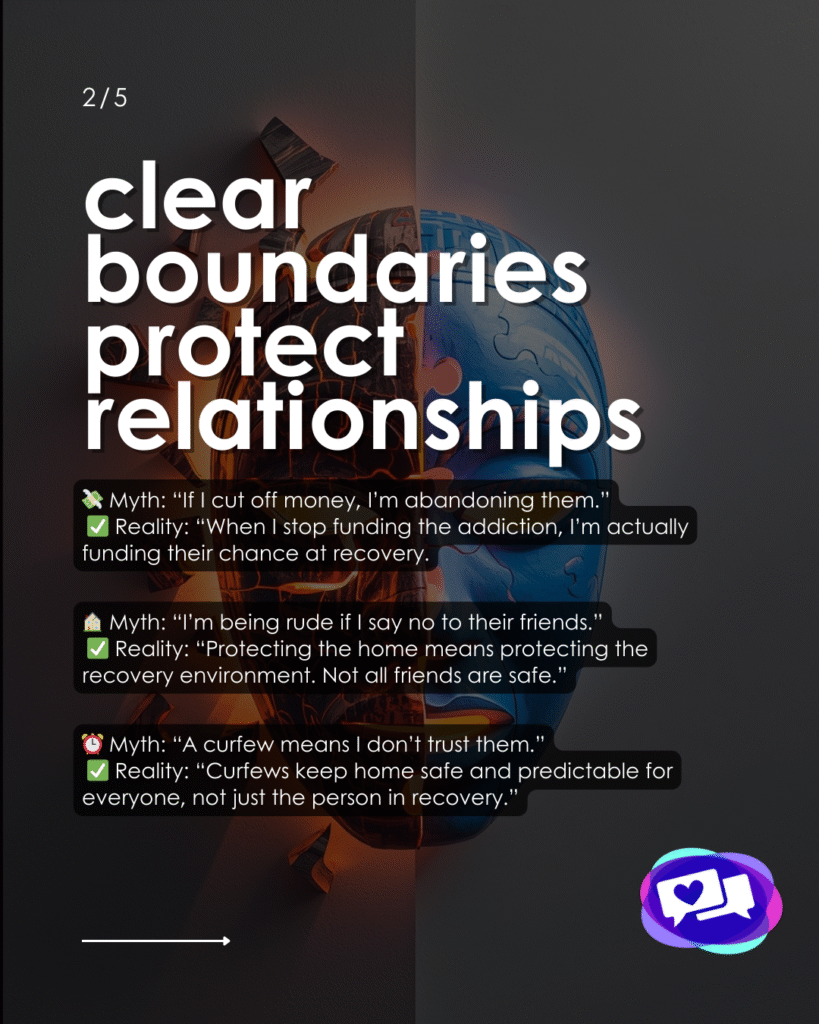
1) Money — “I can’t give you cash, but I can pay directly for food/transport.”
Why it’s necessary: Cash is the most common way families unintentionally enable continued use. Money is fast, anonymous, and easily turned into the thing that destroys recovery.
What it protects/builds:
- Protects the family’s finances.
- Removes an easy route back into substance use.
- Builds accountability — your loved one has to ask for help in safer, specific ways.
How to use it:
- Be specific: “I can’t give cash, but I will buy food, pay bus fare, or help with transport.”
- Offer alternatives that meet immediate needs without handing over cash.
- If you choose to give money later, tie it to clear conditions (proof of meeting attendance, treatment steps, consistent behavior).
Why this script works: It avoids shaming and replaces a vague offer (“I’ll help”) with a safe, concrete offer. It makes support visible and accountable.
2) Curfew — “If you’re not home by 11, the door will be locked.”
Why it’s necessary: Curfews are about routine and safety. Late nights often correlate with higher-risk situations: parties, places where substances are present, tired decision-making.
What it protects/builds:
- Protects household safety and sleep hygiene (which supports recovery).
- Builds predictability — everyone knows what to expect.
- Demonstrates that the family values safety over spontaneity during fragile times.
How to use it:
- Set the time together if possible — joint agreements stick better.
- Explain the reason once: safety, rest, structure. Keep the explanation short.
- Pre-plan exceptions (a wedding? special events?) and how they’ll be handled.
Why this script works: It’s simple and enforceable. Consequences are practical (locked door), not humiliating. You’re protecting the whole household, not policing a person.
3) Phone — “I won’t monitor your calls, but if I see signs you’re slipping I’ll speak up.”
Why it’s necessary: Families sometimes monitor phones out of fear. But covert monitoring destroys trust and drives secrecy — the opposite of recovery.
What it protects/builds:
- Protects privacy and dignity.
- Builds a trust-based relationship where concerns are raised openly, not covertly.
- Encourages honesty instead of clever hiding.
How to use it:
- State your boundary: no monitoring.
- State a clear action if you notice real problems: “If I notice signs of relapse (like lying about meetings, strange money behavior), I’ll speak up and we’ll use the response plan.”
- Offer support: “If you’re struggling, call me first instead of hiding things.”
Why this script works: It avoids the temptation to spy and creates a plan for when concerns arise. It keeps the relationship respectful.
4) Guests — “Our home is a safe space — no friends who are still using.”
Why it’s necessary: Who you let into your house affects the environment. Allowing people who use substances to be in the home is a direct exposure to temptation and risk.
What it protects/builds:
- Protects the recovery environment at home.
- Builds boundaries that help the recovering person avoid risky contact.
- Encourages accountability for who is allowed in the physical space.
How to use it:
- Be clear: “No using friends allowed in the house.”
- Offer alternatives: “If they want to meet, we can meet in a public place during the day.”
- Revisit the rule as the person shows sustained stability.
Why this script works: It’s about controlling the environment, not the person. It’s a safety measure that signals seriousness about recovery.
5) Car Keys — “I can’t lend the car until we have 90 days of consistency.”
Why it’s necessary: Vehicles are a serious safety and financial risk. Giving car access can enable risky behavior (late-night drives, getting to places with substances).
What it protects/builds:
- Protects safety (for the driver and others).
- Protects family property and financial stability.
- Builds responsibility and a clear marker of trust to earn.
How to use it:
- Be concrete: number of days, what counts as “consistent.”
- Pair with a plan: “If you attend meetings and keep appointments for 90 days, we will revisit car privileges.”
- Offer alternatives: rides, bus fare, family drop-offs.
Why this script works: It turns car access into a concrete milestone tied to demonstrable behavior, not feelings or arguments.
If a boundary slips — Repair language that actually helps
Boundaries will be tested. People will make mistakes. How you repair after a slip will determine whether relationships stay intact or break down.
The thinking behind good repair language
A good repair message does three things:
- Acknowledge the slip (not blame, not excuse).
- Own your part (if you crossed a line) or clearly restate the boundary (if they crossed it).
- Offer a next step — a small action that repairs or resets.
Why this works: Short, honest repairs lower defensiveness. They move the conversation from blame to action.
Repair language — templates & examples
Formula A — When you cross your own boundary (family member slips):
- Acknowledge + short apology + reset.
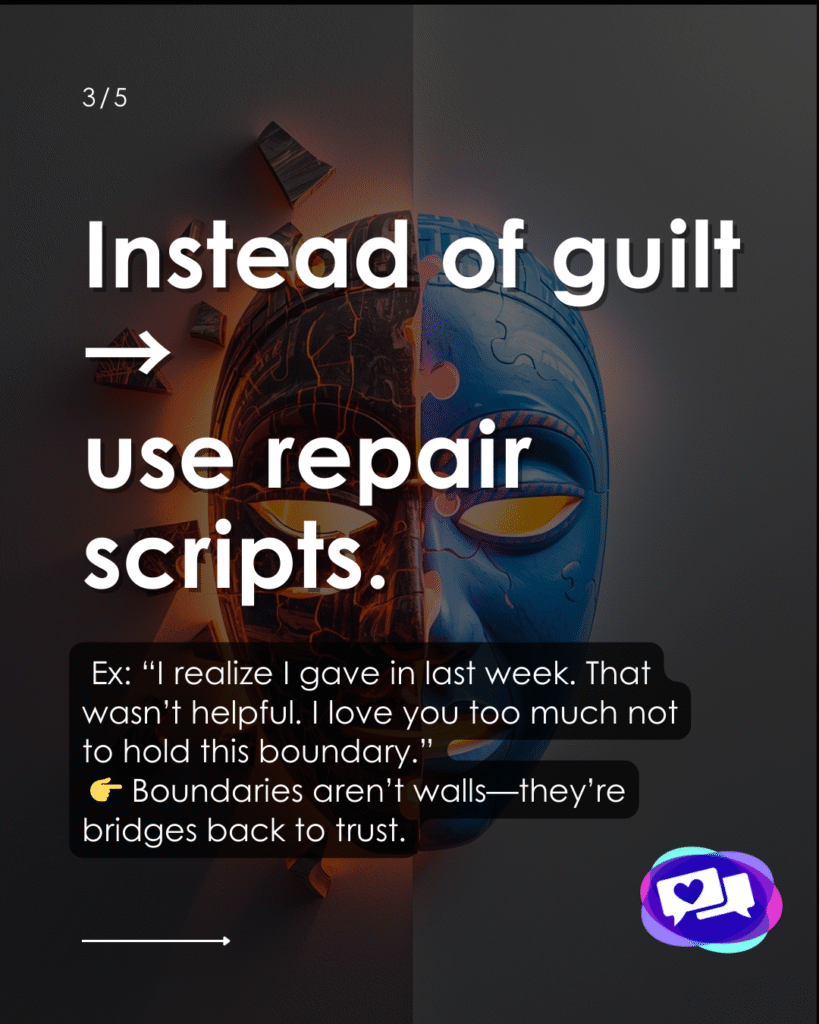
- Example: “I crossed my own line earlier when I gave cash. I’m sorry — I need to reset that boundary. From now, I’ll pay for food/transport instead.”
Formula B — When they cross a boundary (loved one):
- Observation + impact + next step.
- Example: “When you came home past 2am last night, I felt scared and unsafe. I need us to stick to the curfew. If it happens again, I’ll call your sponsor and you’ll sleep here instead.”
Formula C — Small repair after an argument:
- Calm statement + intention.
- Example: “I yelled earlier and that wasn’t helpful. I’m sorry. I still need us to follow the house rule about guests. Can we try again?”
Short repair lines to keep handy:
- “I crossed my line — I need to reset.”
- “That didn’t feel safe; I need to step back.”
- “I love you. I have to keep this boundary — it’s important for both of us.”
How the scripts are formulated — the thought process
When I write a repair or boundary script I think:
- Is this short and clear? Long lectures fail.
- Does it state my need/feeling rather than attack? (“I felt unsafe” vs “You always mess up”)
- Does it give a practical next step? (“I’ll pay for food” vs “You must change”)
- Is it fair and enforceable? If you can’t follow-through, don’t promise it.
That’s why the scripts use “I” statements, specific actions, and short time frames.
Making your own boundary scripts — a quick guide
Use these patterns to create scripts that fit your voice:
- I can’t ___, but I can ___
- “I can’t give you cash, but I can buy groceries.”
- If you ___, then I will ___
- “If you come home after 11, then I will lock the door.”
- I need ___ in order to ___
- “I need honesty in order to rebuild trust.”
- No. (Short + firm)
- “No, I won’t lend the car.”
Practice checklist:
- Keep it < 15 words when possible.
- Use “I” language.
- State the action, not the emotion first.
- Say the consequence calmly and only once.
- Rehearse it out loud once.
What to avoid (and why)
- Blaming or shaming language: triggers defensiveness.
- Long speeches: people shut down.
- Promises you can’t keep: hurts your credibility.
- Monitoring/spying: destroys trust and encourages secrecy.
Practical enforcement tips (so the boundary works)
- Decide consequences ahead of time and communicate them calmly.
- Follow through — inconsistency teaches that boundaries are negotiable.
- Use neutral language (no yelling).
- Use support — tell a sponsor or friend what you’re doing so you have accountability.
- Review & adjust the boundary together if needed — it’s OK to evolve the rule as trust rebuilds.
Quick practice exercise (do this together)
- Pick one boundary you’ll set this week.
- Write the script using one of the templates above.
- Practice it out loud once with a friend or sponsor.
- Post the Boundary Worksheet on the fridge or save it to your phone.
- Share one outcome with the group at Family Healing Night.
Closing — the invitation
Boundaries aren’t cruelty. They’re an act of care — for your loved one and for yourself. When words are short, predictable, and followed by action, they stop chaos and open space for real repair.
📄 Tool: Boundary Worksheet — download and fill together
📅 Join us on zoom to discuss boundaries: Join our community to RSVP here
Related Posts

Rebuilding Trust Without Surveillance: Love, Boundaries & Letting Go of Control

Love After Addiction: What Healthy Relationships Actually Look Like